slots
  • Best Brokers
    • By trading conditions
      • Forex Trading Apps
      • Low Spread Forex Brokers
      • Zero Spread Forex Brokers
      • Low Commission Forex Brokers
      • High Leverage Brokers
      • No Dealing Desk Forex Brokers
      • ECN Forex Brokers
      • Brokers for Scalping
    • By trader type
      • For Beginners
      • For Professional
      • Brokers with Managed Accounts
      • For Social Trading
  • Reviews
    • OKX
    • eToro
    • Kraken
    • Bitget
    • MEXC
    • XTB
    • Deriv
  • Our Team
Generic selectors
Exact matches only
Search in title
Search in content
Post Type Selectors

OKX Exchange Review 2026

Overall Rating: ★★★★☆  3.9 / 5  (methodology: fees 25% / platform 25% / security 20% / assets 15% / regulation 15%)

OKX is one of the most technically accomplished crypto exchanges operating globally in 2026. By objective metrics — fee structure, derivatives depth, platform architecture, and transparency tools — it competes directly with Binance for the top position in the professional trading segment. The spot maker fee of 0.08% and futures base fee of 0.02% are among the lowest available on any major centralised exchange. The unified account model, which allows shared collateral across spot, margin, futures, and options without manual transfers, is a genuine operational advantage for multi-product traders.

What makes OKX a more complicated recommendation than its technical quality would suggest is its regulatory and compliance history. The February 2025 $505 million Department of Justice AML settlement — the largest ever imposed on a crypto exchange at the time — was not a technicality. It reflected systematic compliance failures that allowed the platform to be used for money laundering at scale. OKX responded with a restructured compliance programme, secured a full MiCA licence in the EU (first among global exchanges), re-entered the US market through a new regulated entity in April 2025, and attracted a $25 billion strategic investment from ICE (NYSE parent) in March 2026. These are meaningful rehabilitative steps. But experienced risk management requires acknowledging the history alongside the progress.

The platform in 2026 is substantially more regulated and more transparent than it was in 2023. For traders in MiCA-covered jurisdictions (EU/EEA), the regulatory picture is now genuinely strong. For traders outside regulated markets, the offshore Seychelles entity remains the servicing vehicle, with correspondingly lower protection.

 

Game manager

Michael Varenov

Senior Financial Analyst & Forex Reviewer

Verified by expert

Quick Facts / Platform Snapshot

Founded 2017 (Star Xu; rebranded OKEx → OKX in January 2022)
Operating entity (global) Aux Cayes FinTech Co. Ltd. (Seychelles)
Operating entity (EU/EEA) OKX Europe Ltd. (Malta; MiCA licence from MFSA)
Operating entity (US) OKX US (San Jose, California; re-entered April 2025)
Users 50–70 million across 100+ countries
Strategic investor ICE (NYSE parent); $25B valuation (March 2026)
Regulation MiCA/MFSA (EU) | MiFID II (EU derivatives, 2025) | VARA (Dubai) | AUSTRAC (Australia) | MAS (Singapore) | Seychelles FSA (global)
UK status Not FCA-authorised; FCA public warning issued
US status Restricted global platform; OKX US launched April 2025 (spot only)
Spot fees (global) 0.08% maker / 0.10% taker (base, non-EEA)
Spot fees (EEA) 0.20% maker / 0.35% taker (base, MiCA entity)
Futures/perps fees 0.02% maker / 0.05% taker (base, all regions)
OKB fee discount Up to 40% discount when holding OKB (native token)
VIP tiers 8 levels; top tier: maker rebate -0.005% spot / -0.01% futures
Supported assets 350+ cryptocurrencies; 700+ spot pairs
Derivatives Perpetual swaps, quarterly futures, options; up to 125x leverage on select contracts
Fiat currencies 67 fiat currencies supported for purchase
Proof of Reserves Monthly (43+ consecutive as of June 2026); Hacken-verified; zk-STARK + Merkle tree
Cold storage >95% of assets offline in air-gapped multi-signature wallets
No inactivity fee Correct — no account maintenance or dormancy charges
Demo account Available (paper trading mode)
Web3 Wallet Non-custodial; 100+ blockchains; DEX aggregator, NFT, DeFi
Copy trading Spot and futures; 8,000+ lead traders; performance fee 8–30%
Trading bots 12 pre-built types: Grid, DCA, Arbitrage, Smart Arbitrage, Recurring Buy, others
Islamic account Not explicitly offered; no overnight fees on spot positions


Security and Regulation

OKX’s regulatory position in 2026 is the most complex of any exchange in this review series — and the most important to understand before depositing funds. The platform has simultaneously achieved some of the most meaningful regulatory milestones in the crypto sector and carries the most serious compliance history. Both facts are true and neither cancels the other out.

3.1 Current Regulatory Licences

  • European Union — MiCA licence from the Malta Financial Services Authority (MFSA): OKX was the first global exchange to secure a full Markets in Crypto-Assets licence, passportable across all 30 EEA member states. In February 2026, OKX also obtained a Payments Institution licence under PSD2 from MFSA, enabling stablecoin payment services (OKX Pay, OKX Card) across the EU.
  • European Union — MiFID II: In 2025, OKX secured a MiFID II licence enabling regulated derivatives products across Europe. This also underpins the launch of X-Perps in 2026, extending derivatives access to traditional financial assets including US stocks.
  • Dubai — VARA: OKX holds a provisional Virtual Assets Regulatory Authority licence, one of the few major exchanges to do so, permitting services to investors and financial service providers in Dubai.
  • Australia — AUSTRAC: OKX is registered with the Australian Transaction Reports and Analysis Centre for AML/CTF compliance.
  • Singapore — MAS: OKX holds a Capital Markets Services licence from the Monetary Authority of Singapore.
  • United States — OKX US: Following a complete platform exit in 2023, OKX re-entered the US market in April 2025 through a newly incorporated entity in San Jose, California. The US platform is restricted to spot trading of major assets; derivatives, most margin products, and Web3 integrations are not available to US clients.


3.2 Regulatory Incidents — Full Disclosure

Critical Risk Disclosure

The following regulatory events are material to any risk assessment of OKX. They are presented factually and without editorial minimisation, as they represent real compliance failures, not administrative technicalities.


  • DOJ AML settlement (February 2025): OKX paid a $505 million settlement to the US Department of Justice for Anti-Money Laundering violations. This is one of the largest penalties ever imposed on a cryptocurrency exchange. The settlement covered a period during which OKX systematically failed to implement adequate KYC and AML controls, allowing the platform to be used for illegal transactions. Two senior executives also pleaded guilty to related charges. OKX restructured its compliance programme following the settlement and agreed to an independent compliance monitor for a defined period.
  • DeFi aggregator suspension (March 2025): OKX suspended its DeFi aggregator service after European regulators raised allegations that it was used to process proceeds from the $1.5 billion Bybit exchange hack. OKX denied direct responsibility but suspended the service. This raised questions about OKX’s oversight of its Web3 products alongside its centralised exchange operations.
  • Hong Kong VASP licence withdrawal: OKX’s application for a Virtual Asset Service Provider licence in Hong Kong was withdrawn, effectively preventing OKX from operating as a regulated exchange in Hong Kong.
  • Thailand — SEC complaint (April 2025): The Thai Securities and Exchange Commission filed a complaint against OKX (operated by Aux Cayes Fintech Co. Ltd.) and nine individuals for operating an unlicensed digital asset exchange in Thailand.
  • United Kingdom — FCA status: OKX is not authorised by the UK Financial Conduct Authority. The FCA has issued public warnings about OKX, including a specific notice connected to OKX’s sponsorship arrangement with Manchester City Football Club. UK residents using OKX are accessing an unauthorised service with no UK regulatory protection.


3.3 Security Infrastructure

  • Cold storage: more than 95% of user assets held in air-gapped offline wallets with multi-signature or MPC (multi-party computation) key management.
  • Proof of Reserves: 43+ consecutive monthly PoR reports as of June 2026, independently verified by blockchain security firm Hacken. Reserves confirmed above 100% for all major assets. Uses zk-STARK cryptographic proofs and Merkle tree inclusion verification. Open-source self-verification tools available on GitHub.
  • Platform certifications: SOC 1 Type 2 and SOC 2 Type 2 compliance; CertiK AA security rating, placing OKX among the higher-rated centralised exchanges on technical security infrastructure.
  • User-level controls: TOTP 2FA (authenticator app), anti-phishing codes on all official emails, withdrawal address whitelisting, device session management, API key IP allowlisting, 24-hour withdrawal lock following security setting changes.
  • Derivatives backstops: insurance fund per market, auto-deleveraging (ADL) mechanism for extreme liquidation scenarios.
  • Insurance: OKX’s security fund covers derivatives liquidation shortfalls, not spot custody losses. No government-backed deposit insurance scheme covers crypto assets on OKX.


Trust Score Assessment

MODERATE-HIGH for MiCA-regulated EU/EEA clients. MODERATE for Dubai and Singapore clients. LOW for UK clients (not FCA-authorised). LOW-MODERATE for clients served by the Seychelles entity. The technical security infrastructure is strong. The regulatory compliance history requires that all clients independently assess their risk tolerance before depositing significant capital.

Trading Fees and Real Costs

OKX’s fee structure is one of its strongest competitive advantages — and also one of its more complex areas to navigate. There are two meaningfully different pricing frameworks depending on where you are located, and the EEA/MiCA framework is substantially more expensive than the global schedule.


4.1 Spot Trading — Global Schedule (non-EEA)

VIP Tier / Volume (30d) Maker Fee Taker Fee
Regular (< $1M) 0.08% 0.10%
VIP 1 (~$5M+) 0.07% 0.09%
VIP 2 (~$20M+) 0.06% 0.08%
VIP 3 (~$100M+) 0.05% 0.07%
VIP 4 (~$500M+) 0.03% 0.06%
VIP 5 (~$2B+) 0.02% 0.05%
VIP 6+ (top tiers) -0.005% (rebate) 0.02%


OKB discount: holding OKX’s native token provides a fee reduction of up to 40% on top of the volume-based tier rate. At base tier, paying with OKB reduces the taker fee from 0.10% to approximately 0.06%. This is a meaningful reduction for regular traders willing to hold OKB.


4.2 Spot Trading — EEA Schedule (MiCA entity)

Clients serviced by OKX Europe Ltd. (Malta, MiCA) face a significantly higher base fee structure. This is a direct consequence of the compliance and operational costs of operating under the MiCA framework.

EEA Tier / Volume (30d EUR) Maker Fee Taker Fee
Regular (< €500K) 0.20% 0.35%
VIP 1 (€500K+) 0.15% 0.25%
VIP 2 (€2M+) 0.12% 0.20%
VIP 3 (€10M+) 0.10% 0.15%
VIP 4+ (top tiers) Maker rebates available ~0.05%


At base tier, EU clients pay 0.20% maker / 0.35% taker — 2.5x to 3.5x higher than the global rate. This is a material difference that significantly affects the platform’s value proposition for European retail traders who do not trade high volumes.


4.3 Futures and Perpetual Swaps

Tier Maker Fee Taker Fee
Regular (base) 0.02% 0.05%
VIP 1 0.018% 0.045%
VIP 3 0.015% 0.04%
VIP 5+ -0.01% (rebate) 0.015%


At 0.02% maker / 0.05% taker, OKX’s futures fees are among the most competitive in the industry, on par with Bybit and below Binance. Futures traders also need to account for funding rates on perpetual swaps, which are not a fee charged by OKX but a periodic transfer between long and short positions determined by market imbalance. Funding rates can dominate position economics for positions held over multiple days.


4.4 Options

Options base fee: 0.03% per contract (with per-contract caps). Options are available on BTC, ETH, and selected other assets. The options market on OKX is one of the deeper and more liquid centralised options venues outside of Deribit.


4.5 Non-Trading Fees

Fee type Details
Crypto deposits Free; network fees apply from the sending wallet
Crypto withdrawals Network-only fee; displayed before confirmation. BTC: ~0.0004 BTC; USDT TRC-20: ~2.6 USDT; USDT ERC-20: higher (ETH gas)
Fiat deposits (SEPA) Free (EU/EEA); SEPA Instant available
Fiat deposits (card) Third-party processor fee: typically 1.5–3.5% depending on card and region
Fiat withdrawals (SEPA) No OKX platform fee; SEPA standard 1–2 business days
P2P trading Zero OKX platform fee; payment provider fees may apply
Convert (simple buy/sell) All-in quoted price; spread embedded; no separate fee shown
Inactivity fee None
Account maintenance fee None
Copy trading performance fee Lead traders charge 8–30% of profits (set by each lead trader)


Network selection matters

USDT withdrawal cost ranges from ~1 USDT (TRC-20 Tron) to 15+ USDT (ERC-20 Ethereum) depending on network. Always select the lowest-cost compatible network. Verify the destination address supports the chosen network — sending on the wrong network results in permanent loss of funds.


Trading Platform and Tools

OKX’s platform architecture is designed for active, multi-product traders. The layout is intentionally layered: Spot, Margin, Futures, Options, and Convert on the trading side; Earn, Bots, Copy Trade, Jumpstart, and the Web3 Wallet as secondary product layers. The depth is a strength for experienced users and a potential source of overwhelm for beginners.


5.1 Web and Desktop Platform

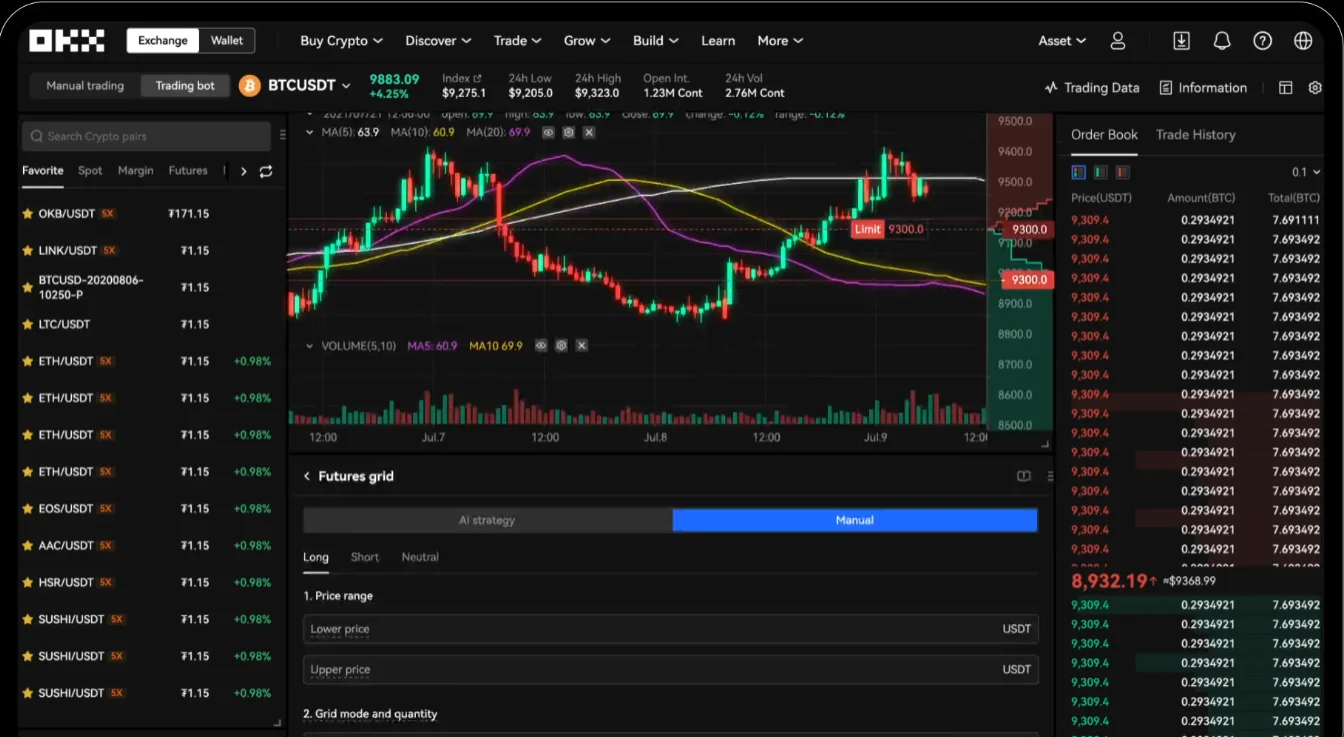
The OKX web platform provides a professional-grade trading interface with TradingView-powered charting integrated directly into the trading view. This gives access to TradingView’s full indicator library, drawing tools, multi-timeframe analysis, and custom scripts without leaving the platform.

Order types available

  • Market order
  • Limit order
  • Stop-loss / Stop-limit
  • Take-profit / Take-profit limit
  • Trailing stop
  • OCO (One-Cancels-the-Other)
  • Post-only (maker-only)
  • Iceberg order (for large positions)
  • Time-weighted average price (TWAP)
  • Fill-or-kill / Immediate-or-cancel


The unified account model is a structural advantage: collateral posted in one product (e.g. BTC in the spot wallet) is available as margin for futures positions without requiring a manual transfer. This reduces idle capital and is particularly useful for traders running multi-leg strategies across spot and derivatives.


5.2 Execution Quality

OKX’s matching engine processes orders with sub-millisecond latency, accommodating both retail manual trading and algorithmic strategies. The exchange has published latency benchmarks and provides a co-location service for institutional and HFT clients. For retail traders using the web or mobile interface, order execution quality on major pairs (BTC/USDT, ETH/USDT) is consistent with a top-tier centralised exchange: tight spreads, minimal slippage on standard order sizes, fast fill confirmation.


5.3 Trading Bots

OKX offers 12 pre-built automated trading strategies accessible without coding knowledge:

  • Grid Bot (spot and futures): places buy and sell orders at defined price intervals within a range
  • DCA Bot: executes purchases at regular intervals regardless of price
  • Smart Arbitrage: cross-exchange or cross-pair arbitrage within OKX’s own markets
  • Recurring Buy: scheduled automatic purchases at set time intervals
  • Signal-based bots: connects to external TradingView Pine Script signals or third-party signal providers via the Signals Marketplace
  • Iceberg and TWAP strategies for large order execution

Bots can be backtested against historical data before deployment. Community-created bots are publicly visible with performance metrics (AUM, backtested APR, user count). Bot availability is geographically restricted in some regions; eligibility should be verified at account level.


5.4 Copy Trading

OKX’s copy trading covers both spot and futures markets, with a network of over 8,000 verified lead traders. Lead traders set their own performance fee between 8% and 30% of profits. Followers can configure allocation caps, stop-loss thresholds, and maximum drawdown limits. Smart Sync automatically sizes copied orders proportionally to the follower’s allocation relative to the lead trader’s position size.

The platform publishes detailed lead trader statistics: historical return, drawdown, win rate, trade frequency, and asset exposure. Track records up to 2 years of history are available for established traders. Past performance is not a predictor of future results — this is an exchange-level disclosure that should be taken seriously.


5.5 Mobile Application

The OKX mobile app (iOS and Android) provides full access to the CEX trading environment and the Web3 wallet within a single interface. The mobile trading view includes the full order type set, TradingView chart integration, bot management, copy trading, and Earn product access. Rated above average for functionality depth among crypto exchange mobile applications.


5.6 Web3 Wallet

The OKX Web3 Wallet is a non-custodial product built into the same app as the centralised exchange. It is fundamentally different from the exchange wallet: you hold the private keys, assets are on-chain, and OKX has no custodial control. Key capabilities:

  • 100+ blockchain networks supported
  • Built-in DEX aggregator (X Routing): routes trades across multiple DEX liquidity sources to find the best execution price
  • NFT marketplace: buy, sell, and manage NFTs across multiple chains
  • DeFi protocol access: direct interaction with lending, staking, and yield protocols
  • Cross-chain bridge: transfer assets between blockchains without leaving the app
  • OKX Pay: zero-fee stablecoin (USDT, USDC) transfers; launched April 2025

The Web3 Wallet carries its own risk profile distinct from the CEX: smart contract risk, routing risk, and the user’s own key management responsibility. The suspension of OKX’s DeFi aggregator in March 2025 following regulatory allegations is a reminder that non-custodial products carry regulatory and operational risks that are not fully within the platform’s control.


5.7 X-Perps and Traditional Asset Derivatives

Launched in 2026 using OKX’s MiFID II licence, X-Perps extends OKX’s derivatives product suite beyond cryptocurrencies to include perpetual contracts on traditional financial assets: US stocks and selected commodities. This positions OKX as one of the first regulated platforms to offer on-chain-adjacent exposure to equity markets through a licensed EU derivatives framework. Availability is currently limited to eligible EEA clients.


Instruments and Markets

6.1 Spot Markets

OKX lists 350+ cryptocurrencies across 700+ spot trading pairs. Base currencies include USDT, USDC, BTC, ETH, and OKB. Liquidity is strongest on BTC, ETH, SOL, and major USDT pairs. Mid-cap and emerging token listings provide breadth for altcoin traders, though order book depth and spread quality vary significantly on lower-liquidity pairs.


6.2 Derivatives: Perpetual Swaps

Perpetual swaps (no expiry) are OKX’s highest-volume product category. Available on BTC, ETH, SOL, XRP, and 100+ other assets in USDT-margined and coin-margined formats. Leverage up to 125x on BTC and ETH perpetuals (lower on other assets). Funding rates are published in real-time. Open interest data is available in the platform’s analytics dashboard.


6.3 Derivatives: Dated Futures

Weekly, bi-weekly, monthly, and quarterly futures contracts available on major assets. Settlement at contract expiry at the index price. Useful for basis trading and calendar spread strategies. Fees identical to perpetuals (0.02% maker / 0.05% taker base).


6.4 Derivatives: Options

OKX’s options market is one of the more liquid centralised exchange options venues, with BTC and ETH options across multiple strikes and expirations. Includes weekly, monthly, and quarterly expirations. Greeks, open interest by strike, and implied volatility data are available in the platform’s options analytics interface. Base fee: 0.03% per contract.


6.5 Margin Trading

Cross and isolated margin available on 600+ spot pairs. Maximum leverage varies by asset and account tier. Margin interest rates are charged in the borrowed asset on an hourly basis. The unified account model allows spot holdings to be used as margin without collateral transfer.


6.6 X-Perps (EU/EEA, 2026)

Perpetual contracts on traditional financial assets including US stocks and commodities, offered under OKX’s MiFID II licence. Available to eligible EEA clients only. This is a new product category in 2026 and carries both the promise of regulatory legitimacy and the limited track record of a recently launched service.


6.7 Geographic Restrictions

The global OKX platform is not available to US residents (OKX US is a separate, restricted product). The full platform is also unavailable in the UK (no FCA authorisation). Access restrictions apply in Canada, Thailand, and other jurisdictions. Feature availability — specifically derivatives, staking, and copy trading — varies by region even in countries where the platform is accessible. KYC level determines withdrawal limits regardless of geography.


Account Types and Conditions

7.1 Account Structure

OKX operates a single unified account with sub-wallets for different product categories (Trading Account, Funding Account, Web3 Wallet). The unified margin feature allows collateral held in the Trading Account to be shared across spot, margin, futures, and options without manual transfers. This is a structural advantage over exchanges that segment margin accounts by product.


Account type Min. deposit Eligibility Key access
Standard No stated minimum (crypto); fiat via third-party processors KYC Level 1 (ID + liveness check) Spot, convert; limited P2P; $5,000 lifetime P2P cap at KYC1
Verified (KYC2) No stated minimum KYC Level 2 (ID + proof of address) Full platform; high daily withdrawal limits; fiat on/off ramp
VIP (1–8) No stated minimum; based on 30d volume or asset balance Volume/balance thresholds Lower fees; dedicated support; institutional features
Paper trading (demo) $0 All registered users Simulated trading with real market data; no capital at risk


7.2 KYC Verification

OKX uses a two-tier KYC system. KYC Level 1 requires a government-issued photo ID and facial recognition, unlocking basic trading functionality with a $5,000 lifetime P2P trading cap. KYC Level 2 adds proof of address and provides access to the full platform, including fiat rails, standard withdrawal limits (up to $10 million per day for verified accounts), and derivatives. Higher institutional tiers may require additional documentation (source of funds, source of wealth).

Verification typically processes in minutes to 24 hours under normal conditions. Delays are more common during peak periods. Completing KYC2 before depositing significant funds is strongly recommended: accounts that trigger compliance flags at the withdrawal stage with incomplete verification face extended holds that can delay access to funds for weeks.


7.3 Demo / Paper Trading

OKX offers a paper trading mode with simulated capital and real market prices across spot and derivatives. This is accessible to all registered users and does not require KYC completion. The paper trading environment replicates the live platform’s order types, fee structure, and execution logic, making it a useful tool for learning the platform before committing real capital.


Deposits and Withdrawals

8.1 Crypto Deposits

OKX does not charge platform fees for cryptocurrency deposits. Standard on-chain network fees apply from the sending wallet. Supported networks per asset are displayed on the deposit screen. Minimum deposit amounts apply per asset and network. For assets requiring a memo or tag (XRP, XLM, EOS), including the correct memo is mandatory to credit the deposit.


8.2 Fiat Deposits

Method OKX Fee Provider Fee Processing Time
SEPA bank transfer (EU) Free None Instant (SEPA Instant) or 1–2 business days
Bank transfer (global) Depends on region Bank charges may apply 2–5 business days
Credit/debit card None 1.5–3.5% (third-party processor) Near-instant
P2P purchase (100+ currencies) Zero OKX fee Payment provider fees Peer-to-peer; variable
MoonPay / Banxa / Simplex None from OKX Processor markup Variable


8.3 Crypto Withdrawals

Crypto withdrawal fees on OKX are network-only: OKX charges no platform markup, passing the on-chain transaction cost directly to the user. The fee is displayed and confirmed before the withdrawal is executed. Reference rates: BTC withdrawal ~0.0004 BTC; USDT on TRC-20 ~2.6 USDT; USDT on ERC-20 significantly higher (ETH gas-dependent). Minimum withdrawal amounts apply per asset.

Security hold: changing account security settings (password, 2FA, anti-phishing code) triggers a 24-hour withdrawal freeze. Withdrawal address whitelisting is strongly recommended as an additional layer of protection against account compromise.


8.4 Fiat Withdrawals

SEPA withdrawals (EU/EEA) carry no OKX platform fee and process within 1–2 business days. Other fiat withdrawal methods vary by region and are processed through third-party payment providers. Fiat withdrawal access requires KYC Level 2 completion. In some regions, fiat withdrawals are not directly available and users must convert crypto to stablecoin and withdraw via P2P or on-chain to an external account.


8.5 Personal Assessment

In test conditions: SEPA EUR deposit credited in under 30 minutes via SEPA Instant. Crypto withdrawal (USDT TRC-20) processed in under 10 minutes with a fee of 2.6 USDT as displayed. The withdrawal interface is clear and fee-transparent. The most significant operational risk in withdrawals is the network selection step — sending on an incompatible network causes permanent fund loss. OKX’s withdrawal interface shows clearly which networks are available per asset and warns on high-fee selections, but the final responsibility for network verification lies with the user.


Education and Market Research

OKX’s educational offering is primarily oriented toward traders who already understand basic market concepts and want to learn the platform’s specific products. It is not a beginner-first educational environment in the style of eToro Academy, but it provides functional content for traders entering the derivatives or automation space.


What is available

  • OKX Learn: structured written and video content covering cryptocurrency fundamentals, technical analysis, DeFi, blockchain basics, and how to use specific OKX products (bots, copy trading, futures).
  • Trading guides: step-by-step guides for each product category (perpetuals, options, grid bots) with worked examples.
  • Market analytics dashboard: real-time open interest, funding rates, liquidation heatmaps, and long/short ratio data for derivatives markets.
  • Historical market data: OHLC data, aggregate trades, and trading history available for spot and futures.
  • Developer documentation: comprehensive REST and WebSocket API docs, including rate limits, authentication, and code examples. The developer lab includes a marketplace of community-built trading bots and indicators.
  • Signals Marketplace: connects to TradingView Pine Script signals and third-party signal providers for bot automation.
  • Research reports: periodic macro and crypto market analysis from the OKX research team.


What is not available

  • Integrated third-party analysis tools (Trading Central, AutoChartist) — OKX relies on its own analytics rather than licensing external signal providers.
  • Structured certification or educational courses with progressive difficulty and assessment.
  • In-platform educational content specifically designed for beginners making their first crypto purchase.

For the target OKX user — an experienced trader familiar with derivatives and automated strategies — the available research and analytics tools are genuinely useful. The funding rate history, open interest by strike for options, and liquidation data are practical inputs for trade planning.


Customer Support

10.1 Support Channels

  • 24/7 live chat: available on web and mobile; initial contact is AI-assisted, with human escalation for account-specific issues.
  • Email / ticket system: for account freezes, compliance-related queries, fund recovery, and formal complaints.
  • Help Centre: extensive self-service knowledge base covering account setup, trading mechanics, fee calculation, and security. Updated regularly; generally accurate on product specifics.
  • Phone support: not available.
  • Telegram and community channels: OKX maintains active official channels; useful for platform announcements and community information but not a formal support route.


10.2 Languages

OKX supports 20+ languages on the platform, reflecting its global user base. Customer support is available in English, Chinese (Simplified), Korean, Turkish, Vietnamese, and other major languages. Support quality varies by language; English and Chinese channels are the most capable.


10.3 Support Quality Assessment

OKX’s overall Trustpilot rating of approximately 2/5 is a material data point and reflects a real pattern: standard technical support queries (fee calculations, deposit tracking, platform navigation) are resolved efficiently. Compliance-related issues — account freezes triggered by AML screening, KYC holds, fiat withdrawal blocks — face systematically slower resolution times, sometimes measured in weeks. This is the primary driver of negative user reviews.

The pattern is consistent with the post-DOJ settlement compliance posture: OKX’s compliance monitoring is more aggressive than pre-2025. For traders who are fully KYC2-verified, use the platform for straightforward trading, and do not trigger AML flags, the support experience is adequate. For accounts that attract compliance attention, the experience can be materially worse.


Final Verdict and Category Ratings

Category Rating Key Factor
Fees — Spot (global) ★★★★★  5.0 0.08%/0.10%: below Binance maker rate; top-3 in industry
Fees — Futures ★★★★★  5.0 0.02%/0.05%: industry-leading; rebates at top VIP tiers
Fees — EEA (MiCA) ★★★☆☆  3.0 0.20%/0.35% base: 2.5–3.5x more expensive for EU retail
Platform & Tools ★★★★★  5.0 TradingView integration; unified margin; full order type set; bots; Web3 wallet
Security (technical) ★★★★☆  4.5 Cold storage; 43+ monthly PoR; SOC 2; CertiK AA; strong user controls
Regulation (EU/EEA) ★★★★☆  4.0 MiCA + MiFID II: genuinely strong post-2025 EU compliance posture
Regulation (UK/Global) ★★☆☆☆  2.0 Not FCA-authorised; Seychelles entity for most global users
Compliance history ★★☆☆☆  2.0 $505M DOJ settlement; DeFi suspension; HK licence withdrawn; Thai SEC complaint
Asset range ★★★★☆  4.5 350+ spot; deep perps; options; X-Perps; Web3 DeFi access
Customer support ★★☆☆☆  2.5 Fast on technical issues; slow and opaque on compliance holds
OVERALL RATING ★ 3.9 / 5 Excellent platform, strong post-2025 EU regulation, material compliance history that elevates risk for non-MiCA users


Who Should Use OKX

  • Experienced active traders, particularly futures and derivatives specialists, who want industry-leading fees (0.02% maker on perpetuals), deep liquidity, and a full professional-grade toolset including unified margin, advanced order types, and algorithmic trading support.
  • EU/EEA traders who can access the MiCA-regulated entity and accept the higher EEA base fee structure in exchange for Tier-1 regulatory protection and investor compensation scheme eligibility.
  • Crypto-native users who want an integrated CEX + non-custodial Web3 wallet with DEX aggregation, DeFi access, and NFT trading in a single application.
  • Advanced copy traders and bot users seeking a platform with institutional-depth automation tools and a large lead trader network.


Who Should Look Elsewhere

  • UK residents: OKX is not FCA-authorised. Using the platform provides no UK regulatory protections. XTB, IG, or OANDA are appropriate regulated alternatives for UK-based traders.
  • Beginners or first-time crypto buyers: the platform complexity, compliance friction, and regulatory history make OKX a poor choice for users who have not yet developed a working understanding of crypto market mechanics and risk management.
  • EU retail traders with low monthly volume: at 0.20%/0.35% EEA base fees, occasional buyers on the MiCA entity pay substantially more than on the global schedule. For low-frequency purchasers, Kraken (EU-licensed) offers better pricing.
  • Traders who require the security of government-backed deposit insurance: no deposit protection scheme covers crypto assets on OKX in any jurisdiction.


Main Alternatives

  • Binance — larger global liquidity, more listed tokens, similar fee structure; carries its own significant regulatory history (Binance.com not available in UK).
  • Kraken Pro — stronger regulatory standing (FCA, MiCA, CFTC-regulated derivatives), lower-volume-friendly fees, better US market access; fewer derivatives products than OKX.
  • Bybit — comparable futures fees (0.02%/0.05%), strong derivatives interface; similar offshore regulatory status outside regulated jurisdictions.


Strengths / Weaknesses

✓

Pros

  • Spot fees: 0.08% maker / 0.10% taker — below Binance and Bybit base rates on the maker side
  • Futures fees: 0.02% maker / 0.05% taker — among the lowest in the industry for perpetuals and dated contracts
  • MiCA licence (Malta MFSA, first major global exchange); MiFID II licence for regulated derivatives in Europe (2025); VARA licence in Dubai; AUSTRAC registration in Australia
  • Monthly proof-of-reserves: 43+ consecutive reports verified by Hacken using zk-STARK and Merkle tree verification; user self-verification tools publicly available
  • Unified account model: shared collateral across spot, margin, futures, and options reduces capital fragmentation
  • Web3 Wallet: non-custodial, multi-chain (100+ blockchains), built-in DEX aggregator, NFT marketplace, DeFi access — integrated into the same app as the CEX
  • ICE (NYSE parent) strategic investment at $25B valuation (March 2026) and institutional collateral framework with BlackRock and Standard Chartered (April 2026)
✗

Cons

  • $505M DOJ AML settlement (February 2025): largest ever penalty on a crypto exchange; reflects real compliance failures, not procedural violations
  • DeFi aggregator suspended March 2025 following European regulator allegations of use in laundering Bybit hack proceeds
  • Hong Kong VASP licence withdrawn; Thai SEC complaint filed April 2025 for operating without authorisation
  • UK: FCA has not authorised OKX; FCA issued public warnings about OKX, including in context of Manchester City sponsorship
  • EEA users face higher base fees: 0.20%/0.35% vs 0.08%/0.10% global rate — a significant structural cost disadvantage under MiCA compliance framework
  • Customer support: Trustpilot rating ~2/5, primarily reflecting delayed resolution of compliance-related account freezes and KYC holds
Visit the site →

Frequently Asked Questions

Is OKX safe to use after the $505 million DOJ settlement?
faq

OKX has significantly restructured its compliance programme following the February 2025 DOJ AML settlement and operates under an independent compliance monitor. The exchange holds a full MiCA licence in the EU and has attracted institutional investment from ICE (NYSE parent). Its technical security infrastructure — monthly proof-of-reserves, cold storage, SOC 2 certification — is strong. For EU/EEA traders using the MiCA-regulated entity, the current regulatory environment is genuinely improved. For traders outside regulated jurisdictions, the Seychelles entity remains, and the compliance history requires individual risk assessment before committing significant capital.

What are OKX’s trading fees?
faq

Spot trading: 0.08% maker / 0.10% taker (global base rate). EU/EEA clients under the MiCA entity: 0.20% maker / 0.35% taker base. Futures and perpetual swaps: 0.02% maker / 0.05% taker. Holding OKB tokens provides up to 40% additional fee reduction. Volume-based VIP tiers reduce fees further, with maker rebates (negative fees) available at VIP 5+.

Can I use OKX in the UK?
faq

No. OKX is not authorised by the UK Financial Conduct Authority. The FCA has issued public warnings about OKX. UK residents do not have regulatory protection if they use OKX. For UK-based crypto trading, Kraken (FCA EMI authorised) or regulated CFD/spread betting providers are appropriate alternatives.

Does OKX offer proof of reserves?
faq

Yes. OKX publishes monthly proof-of-reserves reports, with 43+ consecutive reports as of June 2026. Reports are independently verified by blockchain security firm Hacken using zk-STARK cryptographic proofs and Merkle tree inclusion verification. Users can self-verify their account’s inclusion using open-source tools published on OKX’s GitHub. Reserve ratios have been maintained above 100% for all major assets in all published reports.

How does OKX’s EEA fee structure differ from the global rate?
faq

EU/EEA clients serviced by OKX Europe Ltd. (Malta, MiCA entity) face a base spot fee of 0.20% maker / 0.35% taker — 2.5x to 3.5x higher than the global base rate of 0.08% / 0.10%. This reflects the compliance and operational costs of the MiCA regulated entity. Futures fees (0.02% / 0.05%) are the same across both entities. High-volume EEA traders can reduce costs through VIP tier progression.

What is the OKX Web3 Wallet?
faq

The OKX Web3 Wallet is a non-custodial wallet integrated into the same OKX app as the centralised exchange. Unlike the exchange account, you hold the private keys and OKX has no custodial access to your assets. It supports 100+ blockchains with a built-in DEX aggregator, NFT marketplace, cross-chain bridge, and DeFi protocol access. It carries distinct risks from the CEX, including smart contract risk, routing risk, and the user’s own responsibility for key management. If you lose your seed phrase, assets in the Web3 Wallet cannot be recovered.

Does OKX charge inactivity fees?
faq

No. OKX does not charge account maintenance fees, inactivity fees, or dormancy charges. Accounts with no trading activity for extended periods remain fee-free. The only ongoing potential cost for inactive accounts is if they hold open positions subject to overnight funding rates on perpetual swaps.

top casino

© 2026. All rights reserved.

Our website helps users make more informed decisions when choosing a broker by publishing independent reviews, ratings, and analytical materials. We regularly study the online brokerage market, analyzing trading conditions, service, fees, platforms, and other important parameters.

Our primary goal is to provide objective, honest, and useful information about brokers and financial services. We strive to use current and verified data, but broker terms, fees, products, and other information may change over time.

  • Privacy Policy
  • Terms of Use
  • KYC Policy
  • Cookie Policy